
By TERRY LYONS, Editor of Digital Sports Desk
CHESTNUT HILL – Comedian Bill Murray is now stalking the stands of Conte Forum on the campus of Boston College as opposed to the doldrums of Storrs, Connecticut. The world famous Murray is an ardent supporter of his son, Luke, appointed to the head coaching job for the Eagles last March 26th.
You must wonder if the actor will take his residuals from Stripes or Ghost Busters and help fund a couple blue chip prospects for the Eagles?
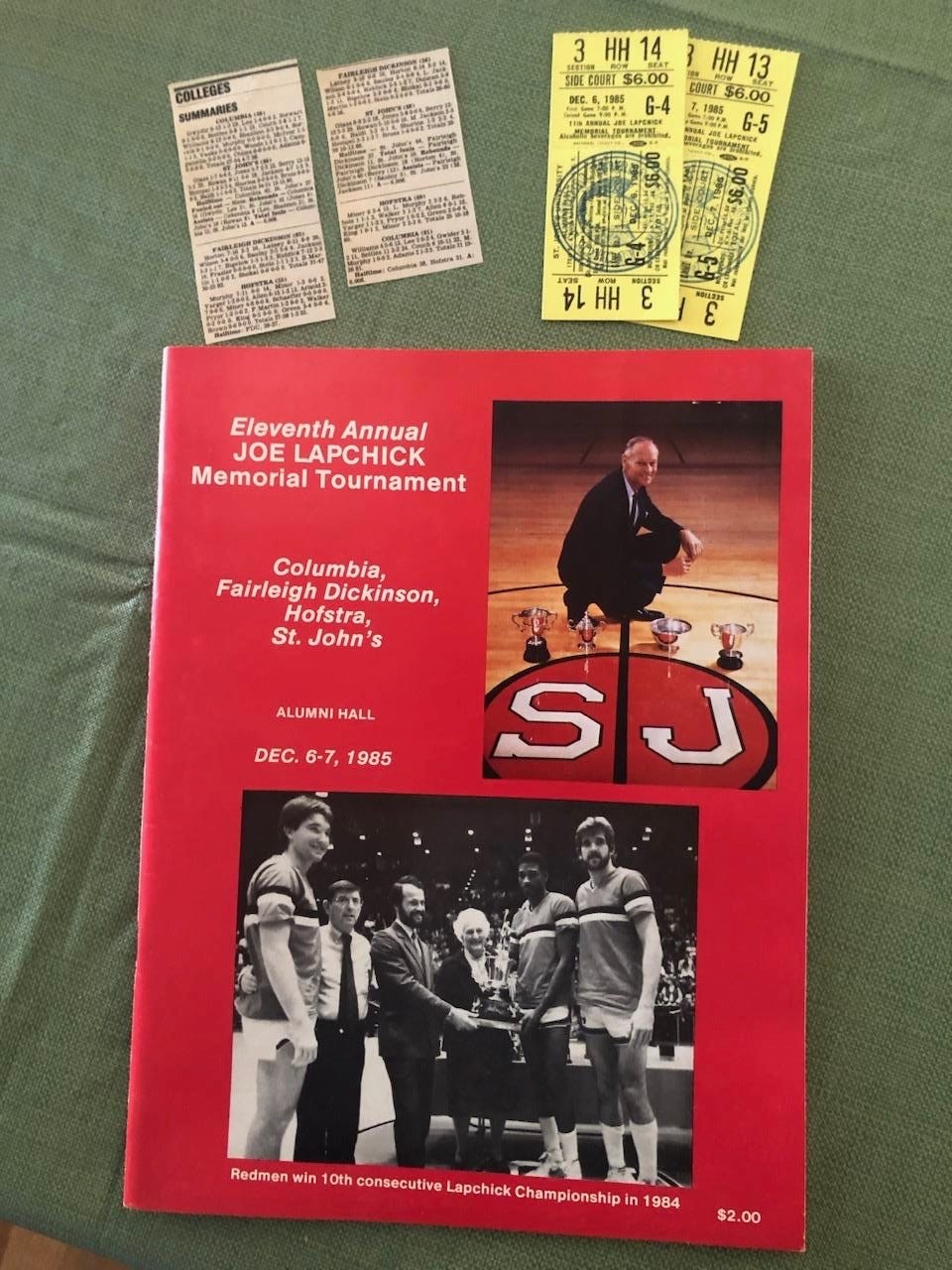
Yes, College basketball has changed. The entire landscape is nothing near the December 6-7, 1985 Joe Lapchick Tournament at then Alumni Hall. As you might note from theimage above, tickets were $6.00 and a game program was $2.00. Little Louie Carnesecca (RIP) used his charm and NYC basketball roots – not his checkbook – to land players like Chris Mullin, Ron Stewart, and Bill Wennington (all pictured).
But, as we all know, the times have changed and St. John’s has ushered in the Rick Pitino era – a time of pay-for-play and two consecutive BIG EAST titles.
Everyone – every college conference commish, all the pundits, the coaches, the alum say the same thing – “The sky is falling for college hoops.” – But if you look at ESPN’s Jay Bilas’ “Bilastrator “Top 65,” its ALL the same elite program teams, in some order or another. While blue blood North Carolina is a little low (30th), the likes of Duke (1), Florida (2), Illinois (3), UConn (4) are all expected to crash the big dance – the same as it ever was – long before the imaginary sky fell on college hoops.
So? What’s the big catastrophe except, admittedly, paying the players multi-millions is NOT sustainable for the long haul, and rich alum (a la Pitino’s buddy Billion dollar Vitamin Water man (Mike Repole) might – eventually – get tired of writing $2m-to-$5m checks.
The question? How long will it go? College basketball is a $20b industry and previously, the AD, coach and school were pocketing the profits. Now the players get a serious cut.
There’s nothing even close to a Collective Bargaining agreement to be had, as the players are not in a position to unionize, and there’s no one for them to negotiate with even if they did. They can’t look at the NCAA, as all the (former governing body) does is lob lawsuits at every player and school.
The conference Commissioners could step up, and run their respective conference like a league of its own, setting guidelines. In fact the SEC is mulling a form of a cap on its member universities, considering a luxury tax to be levied on member schools that spend more on players than the allotted revenue-sharing cap under the House v. NCAA settlement, sources told ESPN on Friday. According to ESPN, “a working group of athletic directors, university presidents and general counsels has been considering the issue the past few weeks, and the league might vote on the issue in the near future, sources said. The SEC would like to approve the luxury tax before the early signing period for football (Dec. 2-4).
Obviously, football is the major factor and basketball (men’s and women’s) fall a bit short in terms of overall budget and spending, considering the size of rosters alone.
The conundrum lies with the fact each and every conference would operate differently, and to its own benefit. What works for the BIG Ten and SEC in football won’t work for the Big Ten and SEC in basketball, nor women’s basketball. And, the guidelines would be far different for the basketball-centric Big East which operates without football in the crosshairs – with the exception of UConn.
What does it all come down to?
What’s good for the Tulsa Community College Geese might not work for the (1904) Drake University Ganders. Go ahead and Google a.i. that one.

HERE NOW, THE NOTES: Speaking of big time college basketball, the season opened with a huge match-up in the first week of play when the Michigan Wolverines met the Connecticut Huskies at a sold out TD Boston Garden (on Friday, Nov. 6).
The doubleheader, sponsored by the Basketball Hall of Fame just down I90 to Springfield, also included a nice cross-the-Commonwealth tilt between the University of Massachusetts (Amhurst) vs the Boston College Eagles. In the early game, Boston’s newly signed coach, Luke Murray, registered his second win of the season (71-55) against no losses. BC’s Money Williams put up 35 points for the local team. That stated, BC also shot 3-for-27 from the three-point arc (11%), duplicating Presidential approval ratings.
Then, the featured event – Michigan vs. UConn – in the nightcap. Considering it’s early November and the teams are still shaking out, the first half of the contest was March Madness tournament material and the partisan Connecticut crowd at the TD Garden was as loud or louder than at any Celtics or Bruins’ playoff game. The first half was fast-paced and incredibly physical, maybe to the point where the refs just gave up.
No. 4 UConn posted an 85-77 victory over No. 16 Michigan, but the key was the 43-30 first half shellacking the Huskies put upon their Big Ten guests. As the season progresses, hoop aficionados should focus on UConn guard Silas Demary Jr. who posted a 21 point, seven rebound and four assist effort while quarterbacking the team’s highly functioning offense. It was only when UConn coach Danny Hurley subbed-in reserve guard Junior County that the Huskies returned to normalcy – meaning a Top 20 team, rather than a Top 5.

TIDBITS & NUGGETS: The WNBA Finals were the most watched league series since 1999, with an average of 1.88 million people viewing the sGolden State win over Atlanta in a decisive Game 7. That game averaged 3.3 million viewers, making it the most-watched WNBA postseason game ever. It was up 128% from last season’s clinching game between Las Vegas and Phoenix that the Vegas Aces won. All seven games in the series were sold out, including Game 6, which was played at 12:30pm ET. The Finals capped the WNBA’s most-watched postseason since its inaugural stint in 1997, averaging 1.49 million viewers, up 27% from last year.
CAN’T MAKE IT UP: College of St. Benedict and St. John’s University (MN) filed a lawsuit in the U.S. District Court of Minnesota Nov. 4 against St. John’s University of New York for its use of the words “Johnnie,” “Johnny” and “Johnnies.” The civil trademark case alleges that, while the Collegeville-based institution was founded in 1857, it has used the terminologies for its students, athletic teams and merchandise since at least 1900. The school in NYC’s borough of Queens (your columnist’s alma mater), has only begun using the terms in recent years, including a virtual assistant on its website named “Johnny” and an annual event “Johnnies Day” which began in 2023.
Back in the day, the New York basketball powerhouse was known as the “Redmen,” a name pegged from the red uniforms its (then) Brooklyn-based football team wore on a weekly basis each Fall. The “Redmen” moniker was scrapped in 1994 when the politically incorrect mascot was retired and Johnny Thunderbird (a lame horse-type creature) repped the new “Red Storm,” a name adopted when it was voted upon by students and fans.
St. John’s of Minny has its claim, so the Redmen/Red Storm should change gears while honoring the late, great coach Lou Carnesecca and forever be known as the “Louie’s.”
THIS JEST IN: Dunkin’ is celebrating its fellow New England icon Rob Gronkowski by renaming three of its locations to “GRONKIN’” for his induction into the New England Patriots Hall of Fame this weekend. From Nov. 6 to Nov. 9, three Foxborough locations will swap out the Dunkin’ sign for Gronkin’ to celebrate the former Patriots tight end.
NBA FRANCHISE VALUATIONS: Each year, our friends at Sportico do the ever-increasing values of NBA franchises. Here’s a graphic to get a lay of the billion dollar land, a layout which is very likely to add new franchises nearing $10b value in Seattle and Las Vegas before the next NBA champion is crowned. Note the growth in value since 2020 when the global pandemic nearly upended all sports activity. Yet, the NBA countered with “The Bubble,” showing the longterm value of sports teams to private equity investors.

BIG BROWN BRUINS: On November 12, the Boston Bruins will take to their home ice to play longtime rival Montreal in their all-new “Remix” uniforms. The duds (which look a bit like Milk Duds) are celebrating Boston’s hockey heritage with a vintage color palette, featuring the all-brown look for the first time since 1924.
The look is a “Varsity Sweater” knockoff, and it includes Ivy League prep stylings that pay homage to the rich collegiate hockey landscape in the greater Boston area. Boston is home to multiple NCAA Division I hockey programs of national relevance, most notably Boston College, Boston University, Harvard and Northeastern – who play in the annual Beanpot tournament on TD Garden ice every February. The Commonwealth of Massachusetts plays host to the most NCAA Division I Men’s Frozen Four team appearances, 19 NCAA Women’s Frozen Four appearances, and the four schools have combined for 11 national titles.
“College hockey is a big part of Boston’s identity, and the tradition and success of the programs in our city have helped make this one of the best hockey communities in the world,” said Boston Bruins President Cam Neely. “The Varsity Sweater is a great way to recognize that history while bringing back elements of the Bruins’ original look. It’s a unique jersey that celebrates both our team’s history and the strong connection between the Bruins and Boston’s hockey community.”
